Salam, Rasamny unveil vision to transform Tripoli
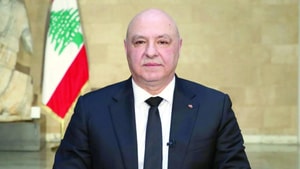
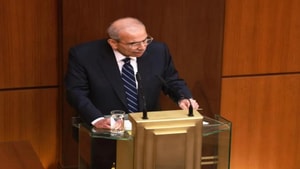
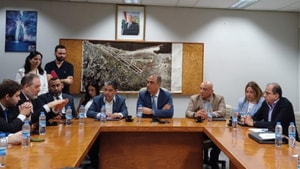
Prime Minister Nawaf Salam sponsored a ceremony at the Grand Serail for the signing of project contracts and memoranda of understanding under the title Tripoli: Strategic Partnerships, Investment Future and Sustainable Development, bringing together the Tripoli Port Authority, Tripoli Special Economic Zone and the Railway and Public Transport Authority.
The event was attended by Deputy Prime Minister Tarek Mitri; Culture Minister Ghassan Salameh; Public Works and Transport Minister Fayez Rasamny; Energy and Water Minister Joe Saddi; Social Affairs Minister Haneen Sayed; Education and Higher Education Minister Rima Karami; Minister of State for Administrative Development Fadi Makki; Cabinet Secretary-General Judge Mahmoud Makieh; as well as MPs, Arab and foreign ambassadors, economic figures and sector stakeholders.
Salam: From Separate Projects to an Integrated Economic System
Salam said the projects and agreements represented a practical step toward a new economic vision for Tripoli, North Lebanon and Akkar after years of missed opportunities, delayed projects and unfulfilled promises.
He recalled Tripoli’s historic position linking the Eastern Mediterranean to its inland hinterland, with its port and railway serving as gateways between the sea and the interior. While wars, crises and neglect had disrupted those advantages, he stressed that geography has not changed.
The question today is not whether Tripoli can regain its role, but how we transform its location, port, human potential, economic zone, Kleyat Airport and transport networks into real economic power, Salam said.
He stressed that Tripoli Port, the Special Economic Zone and the railway must function as a single system rather than separate institutions. The port would provide access to markets, the economic zone would convert trade into investment, production and added value, while rail and transport networks would reduce costs and broaden market access.
Salam outlined a logistics system integrating sea, land and air: Tripoli Port serving trade, imports and exports; the Special Economic Zone attracting industry, services and technology; railways and roads linking them to the hinterland and border crossings; and René Mouawad Airport in Kleyat providing North Lebanon and Akkar with an additional gateway to Lebanon and the world.
He stressed that infrastructure was not an end in itself, but a means of generating jobs, attracting investment and creating opportunities for small and medium-sized enterprises, logistics and technology services, producers and farmers.
This is not a regional project, Salam said. It begins in Tripoli, the North and Akkar, but it serves all of Lebanon. When Tripoli grows, Lebanon grows with it.
Salam said implementation was already underway. A new board had been appointed at Tripoli Port, alongside work on a strategic development vision, infrastructure modernization, services and digitalization. The Special Economic Zone had been reactivated and placed on a public-private partnership track, while work had begun on its licensing framework and one-stop-shop system.
He also pointed to the commissioning of consultancy work to review and update the design of the Tripoli-Abboudieh railway line, progress in rehabilitating René Mouawad Airport in Kleyat, and renewed efforts to activate the Rachid Karami International Fair.
We are not talking about a vision that we want to begin, but about a vision that has already begun, Salam said, stressing that success would be measured through bankable projects, transparent procedures, clear licensing and institutions that respect laws, contracts and deadlines.
He also underscored the importance of partnership with Lebanon’s private sector, saying the state’s role was to establish rules, develop infrastructure, guarantee transparency and competition and protect rights, while private investment and enterprise remained essential to production and job creation.
Rasamny: Tripoli Is Entering a New Phase
Rasamny said Tripoli was entering a new phase after years in which its potential had exceeded the attention and investment it received.
He identified Tripoli Port’s location as its fundamental strategic advantage: a position on the Eastern Mediterranean close to the Arab hinterland and regional markets, with waters capable of supporting its development as a deep-water port.
Our responsibility is to build the infrastructure, connectivity, services, management and environment that attract investment, Rasamny said.
With the support of President Joseph Aoun and under Salam’s government, Rasamny said the objective was to transform Tripoli Port from a local cargo-handling facility into a regional logistics hub in the Eastern Mediterranean.
He highlighted what he described as an unprecedented level of institutional integration between Tripoli Port, the Special Economic Zone, the Railway and Public Transport Authority and relevant ministries.
Rasamny pointed to Tripoli Port’s contribution toward financing the updated study of the railway connection from the port to the Syrian border, as well as a study of the Special Economic Zone’s legal and regulatory framework and licensing system.
This is genuine partnership, not merely coordination between institutions, he said, describing it as a model in which public institutions share resources and responsibility in pursuit of a broader economic objective.
Tripoli Port Capacity Targeted to Rise from 250,000 to More Than 1.8 Million TEUs
Turning to implementation, Rasamny said around 20 development projects were planned at Tripoli Port over the next three years.
These include a modern customs inspection yard currently under construction, an upcoming tender for modern warehouses, including refrigerated facilities, and plans to introduce a Port Community System to make port procedures more digital, faster and more transparent.
The most significant transformation, he said, would involve container capacity.
Expansion of the existing terminal is expected to raise maximum annual capacity from around 250,000 to approximately 800,000 TEUs. Bids have already been opened, with the port moving toward awarding the contract in the coming weeks.
A subsequent expansion phase envisaged under the port’s master plan would ultimately raise total capacity to more than 1.8 million TEUs annually.
From 250,000 today to more than 1.8 million, this is not an adjustment to the port’s capacity. It is a change in its scale and its role, Rasamny said.
He said the additional capacity would create room for new shipping lines, operators, capital and logistics and industrial activities surrounding the port.
Rail Link Could Open Tripoli to Iraq, Jordan, Gulf and Turkey
Rasamny stressed, however, that expanding capacity inside the port would have limited impact if goods could not move efficiently beyond its gates.
He identified the priority railway project as reconnecting Tripoli Port to the Syrian border through Abboudieh and onward to Homs and the Syrian railway network.
Rasamny said he and Syrian Transport Minister Yarub Badr had agreed to establish a joint Lebanese-Syrian technical team. Work would begin with reviewing and updating existing studies and examining routes, technical requirements and projected freight traffic before moving to implementation and financing requirements.
The ambition, he said, extends beyond the Lebanese-Syrian border.
If we can connect Tripoli Port to the Syrian network, and from there to transport networks toward Iraq, Jordan, the Gulf and Turkey, we open a market for the port that is far larger than the Lebanese market, Rasamny said. This is where geography becomes economics — the sea on one side, the regional hinterland on the other, and Tripoli between them.
Rasamny to Investors: Put Tripoli on Your Radar
Addressing investors directly, Rasamny urged them to put Tripoli on your radar, stressing that the opportunity was based not on promises but on tangible, measurable projects.
He pointed to the expanding port, the Special Economic Zone, the revived railway connection and Kleyat Airport as complementary elements capable of attracting industrial and logistics investment and generating added-value services.
Rasamny said the broader objective was also to change the way development in North Lebanon is viewed.
For a long time, when we spoke about Tripoli and the North, the question was: What does the North need from the state? Today, we must add another question: What can the North add to the state’s economy? he said.
Tripoli is not only a city that needs development; it is a city capable of producing it.
Rasamny stressed that the success of Tripoli Port would therefore not be measured solely by container volumes, but by jobs created, investments attracted, businesses generated and markets opened.
That is how a port moves from being a transport facility to becoming an engine of the economy, he said.
Concluding, Rasamny said the goal was to restore Tripoli’s role and translate its potential into investment, growth and opportunity.
Because Tripoli’s success is the success of all Lebanon, Rasamny concluded. Tripoli is for all Lebanon.