Jaber from Paris: Lebanon's commitment to reform and recovery remains intact despite immense challenges
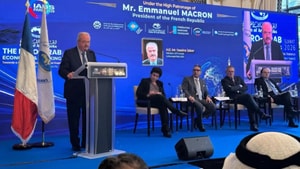
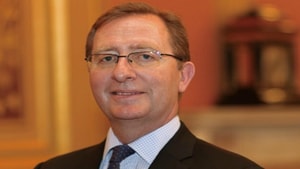
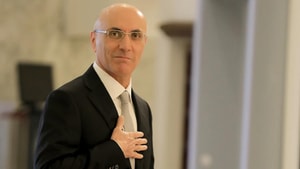
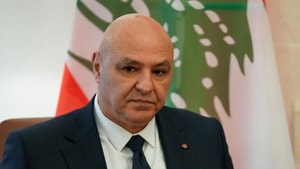
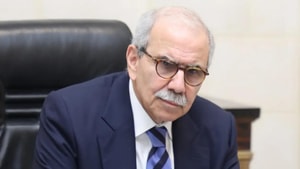
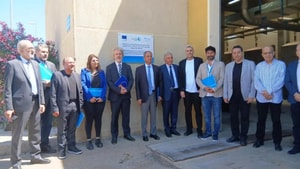
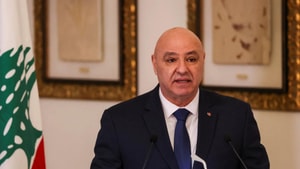
In his delivered word at the 2026 Arab-European Banking and Economic Summit, held in Paris under the patronage of French President Emmanuel Macron, Finance Minister Yassine Jaber said:
Excellencies,
Distinguished Guests,
Ladies and Gentlemen,
Allow me to begin by expressing my appreciation to the organizers of the Euro-Arab Economic and Banking Summit.
We meet at a time when the global economy is undergoing profound geopolitical and financial transformations. International alliances are being reshaped, trade and financial flows are becoming increasingly fragmented, and uncertainty surrounding energy security, supply chains, and investment is growing.
These are not abstract global trends. They are directly affecting our economies, financial systems, and development prospects.
For countries like Lebanon, situated at the crossroads of Europe and the Arab world, these developments present both significant risks and important opportunities.
Today, energy security has become inseparable from economic and financial stability. Energy disruptions and price volatility are among the principal drivers of inflation, fiscal pressures, and market uncertainty worldwide, and for importing countries like Lebanon, a heightened risk on balance of payments and foreign exchange reserves. This reality underscores the urgency of investing in energy diversification, regional interconnections, renewable energy, and resilient infrastructure. The energy transition is no longer solely an environmental objective- it has become a financial, economic, and geopolitical necessity.
At the same time, we are witnessing important shifts in the international monetary and financial landscape, reflecting broader concerns about geopolitical risk, financial fragmentation, and the resilience of the global financial architecture.
In this environment, emerging economies must strengthen macroeconomic management, adopt prudent and credible fiscal and monetary policies, reinforce institutions and regulatory frameworks, and deepen regional cooperation to better withstand external shocks.
Against this backdrop, there is a compelling case for stronger Euro-Mediterranean and Euro-Arab cooperation, not only as a framework for economic integration, but as a platform for regional stability, investment protection and shared resilience.
The Mediterranean must not become a fault line between crises. It should serve as a bridge for connectivity, trade, investment, energy cooperation, and financial partnership between Europe and the Arab world.
Our regions possess complementary strengths: capital, markets, energy resources, human talent, logistics networks, and financial expertise. Unlocking these complementarities can create new engines of growth and resilience for both sides of the Mediterranean.
Allow me now to speak briefly about Lebanon.
I would have preferred to stand before you today to discuss Lebanon's reform progress towards rebuilding confidence, our recovery efforts restoring institutions, and our aspirations for a new chapter of stability and prosperity.
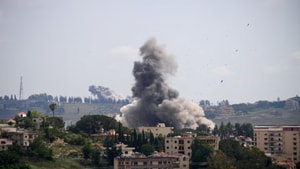
Instead, I stand before you while Lebanon endures one of the most devastating periods in its modern history.
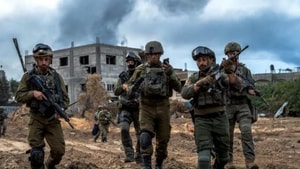
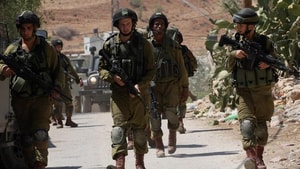
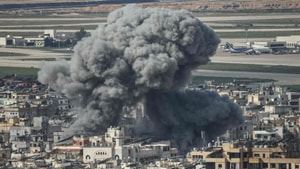
The ongoing conflict has imposed devastating human and economic costs: Entire villages have been reduced to rubble, communities have been uprooted from lands to which they have belonged for generations, massively displaced; home, schools and infrastructure have been destroyed, centuries of cultural heritage have been damaged or erased, economic activity has been severely disrupted, and public finances are under immense pressure. Beyond the material losses, there is a profound human cost that cannot be measured in economic statistics alone: the loss of lives, livelihoods, security and hope.
Yet despite these immense challenges, the resilience of the Lebanese people remains unwavering.
Our commitment to reform and recovery remains intact. We continue to advance governance, fiscal, and financial sector reforms, preserve institutional continuity, and lay the foundations for recovery, reconstruction and sustainable growth. We view an IMF-supported program as a critical pillar of Lebanon's recovery strategy—a framework that can help restore credibility, guide reform implementation, unlock external financing, and support a durable return to growth and stability.
We continue to believe in a future where Lebanon can once again serve as a bridge between Europe and the Arab world, a regional center for finance, entrepreneurship, innovation, and human capital. We remain committed to restoring confidence, capitalizing on our accumulated expertise and reviving the country’s pioneering role in banking services in the region.
However, recovery cannot happen without security. No reform agenda can succeed in an environment of persistent conflict and uncertainty. Lebanon needs, above all, a cessation of hostilities and a return to durable stability that enables investment, reconstruction, and economic renewal.
Allow me to conclude with one central message.
The future of Euro-Arab cooperation should not be defined solely by crisis management. It should be driven by a shared vision for economic resilience, regional integration, investment, and sustainable growth.
In an increasingly fragmented world, cooperation itself has become a strategic asset.
By strengthening partnerships between Europe and the Arab world, we can build more resilient economies, support energy transitions, promote investment and innovation, and create opportunities for future generations across our region.