Salamé, Russian Ambassador discuss expanding cultural ties and digitizing Mmanuscripts
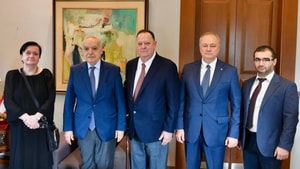
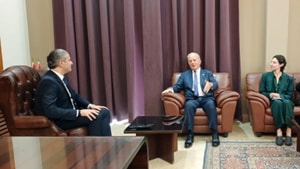
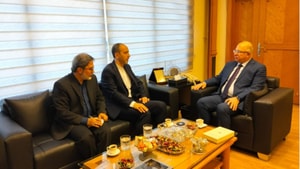
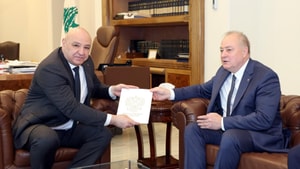
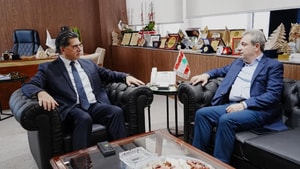
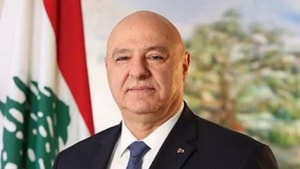
Minister of Culture Ghassan Salamé received Russian Ambassador to Lebanon Alexander Rudakov at his office at the National Library, accompanied by a Russian delegation comprising Minister-Counsellor Vadim Kirpichenko and Dr. Vladimir Sautov, Deputy Scientific Director of the Institute of Oriental Studies at the Russian Academy of Sciences.
Discussions focused on strengthening cultural cooperation between Lebanon and Russia, particularly with the Institute of Oriental Studies, as well as exchanging expertise in manuscripts and historical documents, digitization and scientific research.
Following the meeting, Sautov thanked Salamé and praised his efforts to strengthen Lebanese-Russian cultural relations.
We discussed ways to continue developing cooperation with Lebanon, a country we deeply appreciate and hold in high regard, Sautov said.
He emphasized that cultural ties between the two countries dated back centuries and were rooted in longstanding friendship, noting that the Lebanese Ministry of Culture would become more extensively involved in future cooperation.
Sautov highlighted Russia’s extensive expertise in Oriental studies and its significant collections of historical manuscripts.
He recalled that Russia’s first collection of Arabic manuscripts was acquired following the establishment of the Asiatic Museum in 1818, with approximately 700 manuscripts purchased in Lebanon from the French consul.
He also praised Salamé’s familiarity with Russia, recalling his previous visits, and expressed hope that cultural cooperation would soon be strengthened through joint projects reflecting the depth of historical relations between the two countries.
For his part, Salamé thanked the Russian delegation and Ambassador Rudakov for facilitating the visit.
We remain open to cultural cooperation with our Russian friends, as the cultural relationship between our two countries is deeply rooted in history, stretching back centuries rather than decades, Salamé said.
He stressed the importance of maintaining the frequency and scope of cultural, artistic and scientific exchanges, particularly with the Russian Academy of Sciences in Moscow and Russia’s institutes of Oriental studies.
Acknowledging Lebanon’s current financial constraints, Salamé emphasized that the determination to strengthen bilateral cooperation remained firm.
He pointed to ongoing cultural exchanges, including the participation of Lebanese children in artistic activities in Moscow over the summer and the enrollment of hundreds of Lebanese students at Russian universities, although their numbers were lower than during the 1960s and 1970s.
Salamé identified the exchange of digitized manuscripts and documents as a priority for future cooperation.
Russia is more advanced than Lebanon in digitization, but we are working to develop our capabilities to a level that will allow us to exchange digitized manuscripts and documents electronically, he explained.
Addressing prospects for expanding official relations, Salamé noted that several Lebanese officials had already visited Russia, while additional visits were being prepared.
He expressed hope that he would soon travel to Moscow himself for consultations on cultural matters and potentially sign a bilateral cultural cooperation program.